4 Hour Marathon Training Plan and Training Tips

A marathon is not just 26.2 miles, it’s months of training, smart recovery, and good nutrition to get to the start line feeling strong, confident, and healthy. A 4 hour marathon training plan is designed for someone who has covered the distance before and is ready to put additional pieces in play to hit their goal.

The average marathon time in 2025 was 4:30:00; the average men’s marathon time was 4:15:00 and the average women’s marathon time that same year was 4:45.
Thus the sub 4-hour marathon goal is one that requires additional fitness, focus, and mental determination. It’s absolutely possible with the right training, but that doesn’t always mean it will happen the first time around either!
I know many runners who took multiple races to BQ, multiple races to cross the sub two half marathon barrier and the 4 hour marathon. Patience with the process and getting the right race day are part of the process.
What to Consider Before Training for a Sub 4-Hour Marathon
Before you commit to a time goal like a sub-four hour marathon training program, you need to consider a few different factors:
1. Level of Experience
If you’re an absolute beginner, I recommend going for one of my beginner marathon training plans or even a couch to marathon plan for your first one.
This plan is designed for runners who have already trained for a marathon and have run at least one.
This is going to be a 16 week training plan, so it’s important that you have somewhat of a base already built heading into it. Plus, you’ll be running 20+ miles in your very first week of the plan.
Having some previous running experience is important to take on the challenge of a sub 4-hour marathon pace without injury.
2. Average Weekly Mileage
I mentioned in my previous point that this plan starts off with 20+ miles in the very first week. This means you need to be running on average around 20 miles weekly to start training with this plan.
This is mainly to prevent any injuries and to stay safe while training. The general rule of thumb is to not increase mileage or intensity drastically and to increase it by 10% week by week. Keep this in mind before you decide to start training.
3. Average Mile Pace During Last Marathon
Calculate your average mile pace during your last marathon and consider it at various stages of the marathon itself.
Were you running at a decently fast pace up until a certain milestone during the race, like the 20-mile marker? Or did you add additional minutes to your overall time because of a porta-potty break?
Before committing to this time goal, it’ll help to figure out how else you can improve your marathon time.
What’s a Four-Hour Marathon Pace?
The 4 hour marathon goal pace is 9:09 per mile.
But no one wants to finish at 4:01, so we usually set our goal pace closer to 8:50-8:55.
This training plan is to finish a marathon within 4 hours and the strategies are designed to help you find the pieces you need to tweak to hit that big goal.
4 Hour Marathon Training Plan
All marathon training plans are divided into sections to help maximize your fitness. You’ll also find that most plans are designed with a cycle of 3 weeks of building and then a cut-back week.
This is because in recovery, our body catches up to the work we’ve done and thus we see the gains! If you never rest and never take the cutback week, you will either burn out, get injured, or simply plateau.
Allow yourself to embrace these moments in training, and remember that bouncing from plan to plan will make it much harder to hit your goal. Plans are designed to work in a systematic way.
Ready to get going?
👉Download the free printable 4-Hour Marathon Training Plan here >>
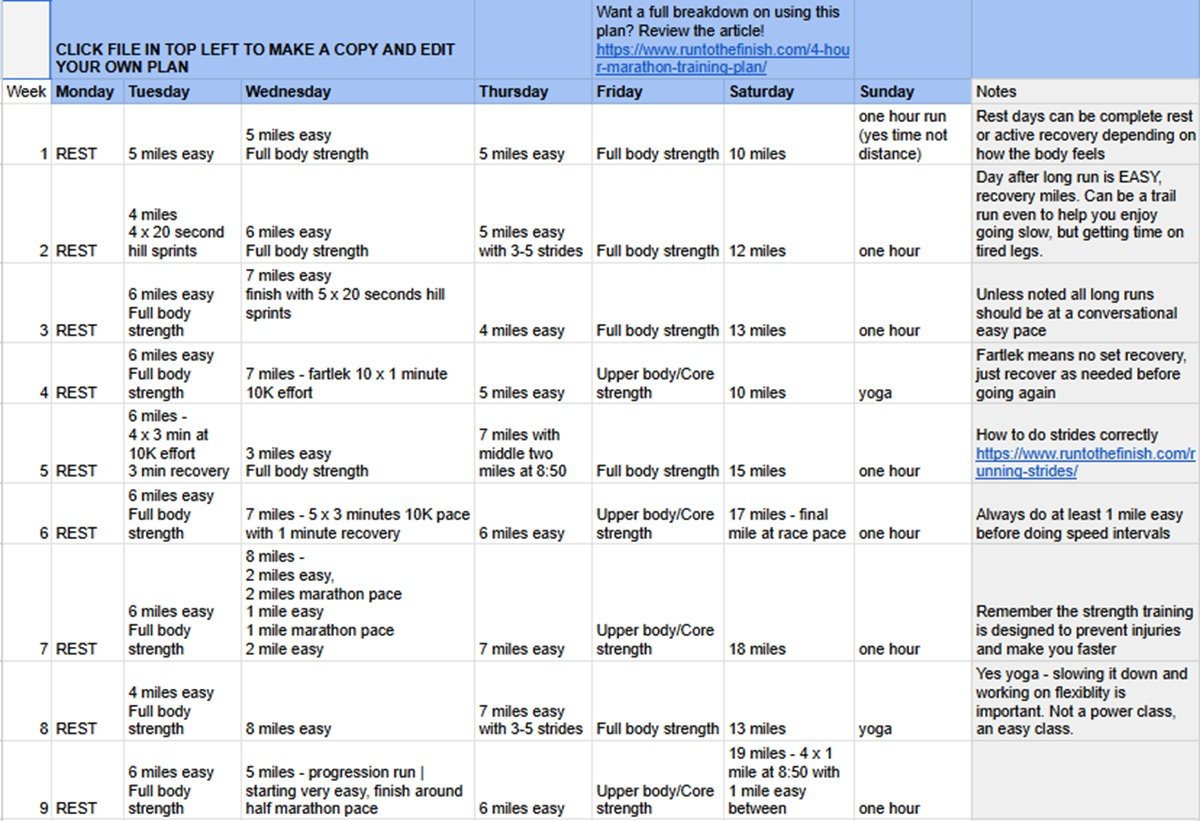
Please note that in this plan, you will see scheduled cutback weeks for recovery. Don’t try to do more during those weeks; let your body adapt to the training.
If you’re looking for something that is more custom to your individual goals, don’t forget you can always reach out to us for 1:1 coaching!!
Weeks 1-5
Base building is the foundation of a great marathon. During this time, we are focused on slowly increasing your weekly mileage while also developing your muscle power.
This is the time we want to ensure no strength training sessions are missed and that you work with heavy weights. Building muscle before starting to run farther and harder means it will help to prevent injuries and you’ll be more likely to maintain muscle throughout marathon training.
We’ll also be mixing things up, with fartleks being introduced in week 4, followed by yoga (yes, yoga!) for your active recovery. It’ll help stretch out the muscles, increase blood flow, and help with recovery.

Weeks 6-10
Now we’re starting to fine-tune training. That means we’re adding in more goal pace miles to help the body learn exactly how it feels to run at race pace and we’re continuing to build weekly mileage.
This is the part that will ask you to do things you haven’t done before and train your body to handle more while also embracing recovery.
It’s super important to stick to the schedule and incorporate strength training as mentioned in the plan. It’s designed to prevent injuries and make you even faster.
Weeks 11-14
Peak weeks during training are when things hit their toughest. This is the point where the mileage is the highest, the speed workouts are the hardest and it becomes a matter of working through the mental part of pushing through.
This is where you are building massive fitness that will be realized by the coming recovery.
Weeks 15-16
Taper time to race day! In the final two weeks, we are focused on maximal recovery.
While you will be reducing the volume of training, it’s ok to still throw in some intensity with intervals to keep the legs feeling fresh. You will also notice that we remove all strength training besides core work because we don’t want to be breaking down muscles.
All of our attention is focused on repair, rest, and recovery.
4 Hour Marathon Training Tips
Setting the goal of a 4-hour marathon can feel scary, but don’t let that fear get in the way! Take it one run, one week of training at a time as you build your fitness towards your big goal.
Our team has put together these training tips so that you can get the most out of your 16 weeks of prep!
Optimize Your Nutrition
Our friend, Cortney Berling, RD, has some great tips for marathon training (and race day!)
- Practice your nutrition prior to race day. Never ever try anything new on race day!
- Fuel early and often. One of the biggest mistakes I see runners make is waiting until they are cramping up to take in nutrition.
- A general fueling goal is 30-60 grams of carbs per hour of running (after the first hour). So a 4 hour marathoner should consume around 90-180 grams of carbs in the race.
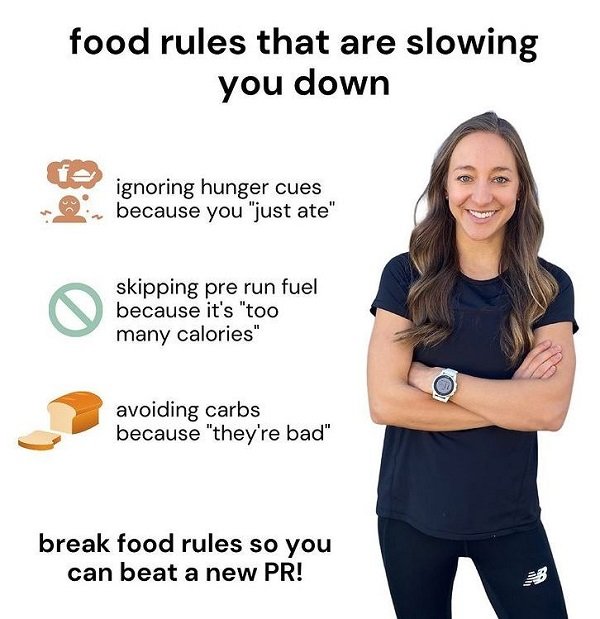
Check out these tips for nailing your marathon fueling strategy.
Spice Up Your Long Run
Long runs are a great time to test everything out, including running at different paces. Yes, the majority of your long runs should be at your easy pace, but spicing things up by throwing in a workout will help on race day.
Here are a few things our team will add for their athletes:
- Strides and surges in the long run
- Marathon-paced intervals
- Tempo miles
- Progression runs
- Fast finishes to practice that final kick
Learn to Run Easy
We will say this until we are blue in the face, but learning how to TRULY run easily is a game-changer.
Being able to set clear differences between hard and easy – no more grey zones, will mean that your body will be able to push the effort on marathon day.
An easy run isn’t a pace; it’s an effort. And that effort will vary each day depending on factors like stress, hydration, nutrition, and even sleep.
You must let go of your mile pace on easy days and instead focus on being able to carry on a conversation. Easy runs are about building endurance, time on feet, and often recovery from hard days.
Don’t Skip Cross Training
We hear the word cross training a lot, but I think runners often take it to mean doing cardio in a different form. While it can be great to get in some biking and swimming, our main focus is strength training.
- Lifting heavy early in training builds muscle for power
- Lifting during training builds endurance and prevents injuries
- 30 Day Core Program – gives you 10 minutes pre-run to work your abs, hips and glutes
- Neglecting strength doesn’t seem like an issue initially, but it is often the downfall around peak week
If you need a little extra motivation for those harder workouts, check out this list of the best running songs.
You can run a marathon without doing all the things right.
But hitting your next level goal requires giving it just a little more commitment. It’s taking your fitness level from good to better by being willing to do the warm-up, do the strength, and do the recovery.
As it all becomes more routine, you’ll find these things can be done fairly quickly.
If you haven’t yet, snag this free plan that you can download and begin using to hit your goal!
What to read next?
- Marathon Pacing Strategy
- Marathon Fueling Strategy
- 10 Best Marathon Running Shoes Ranked: Speed, Cushion, and Support
Other ways to connect with Amanda
Instagram Daily Fun: RunToTheFinish

Facebook Community Chatter: RunToTheFinish
Sign Up to Receive a Weekly Newsletter of Tips
The post 4 Hour Marathon Training Plan and Training Tips appeared first on RunToTheFinish.