12 Week 10k Training Plan Downloadable For Beginner to Intermediate Runners

The 10k is a sweet spot distance if you’re not quite ready for something longer but want a little more challenge than a 5k. We put together this 12-week beginner-to-intermediate 10k training plan to help guide you toward a strong race day.
 If you’re new to running, before jumping right in, we encourage you to check out our Couch to 10k Plan. Here we’re going to assume you’re already putting in some miles and are ready to try something a little bit more for your next 10K!
Depending on your goal, some of these workouts will push you out of your comfort zone and help you sustain a harder effort for longer. Remember, your goal pace isn’t supposed to feel easy at the beginning!
This 12-week 10k training plan sits right in the middle. It’s not for brand-new runners tackling their first 10k race, and it’s not built for elite-level athletes either.
It’s for runners who already have a base and want to become more comfortable with discomfort as they learn to race the distance.
👉Get our free downloadable 12-week 10k Training Plan and start using it to train!
Who is this 12-Week 10k Training Plan for?
This 12-week training plan will be perfect if you have a solid base of running or using the run-walk method before starting.
You should be able to run around 15-20 miles per week and have some experience with speed workouts.
This isn’t an ideal plan if you’re just starting your running journey, since it includes some higher-intensity days. Jumping into a plan that is too much, too soon could put you at risk of overtraining or injury.
12 Week 10k Training Plan Breakdown
In this 12 week plan, you’ll see a variety of workouts to help build your endurance and prepare you to run a strong 10k.
You’ll practice everything from your goal race pace; some workouts will be a little faster, and there will also be a few long runs with some speed incorporated. The goal of all the workouts is to help you feel more comfortable with running your goal pace AND to have some energy left for that final push to the finish line.
Not sure what your race day pace should be? Check out this article with some tips on picking your 10k goal pace.

When starting this plan, you should be able to comfortably run 4-5 miles for a long run and 15-20 miles per week.
Make sure to look ahead at the course map to see if there’ll be any elevation changes.
If your race is going to have some hills, make sure you’re adding similar routes to your training so you get comfortable tackling the uphills and downhills, especially on race day.
If you’re going to use the treadmill throughout training (treadmill miles count too!!), Here are some tips for using your watch vs. the treadmill to track accurately.
👉Get our free downloadable 12-week 10k Training Plan and start using it to train!
Weeks 1-4 (Base)
The first few weeks of the plan are when we will build on the base that you already have coming into training.
Trust us, we completely understand how exciting it is to get started, but that doesn’t mean going full speed and running all the miles right at the beginning.
This is the time to ease into training so that you don’t do too much too soon and burn out or get injured.
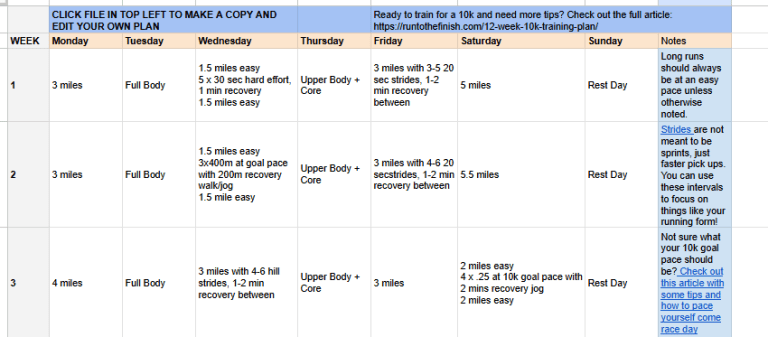
Every fourth week, you’ll see a scheduled cutback week. And you might wonder, why am I already taking a rest week when I’m feeling good? But these weeks are there for a reason to help your body absorb training, recover, and start the next week feeling fresh.
As tempting as it might be, don’t skip them, and definitely resist the urge to add extra workouts.
Weeks 5-8 (Strength + Speed Development)
Here is where the fun begins. Okay, the whole training cycle is fun, but here you’ll start to see workouts designed to help you prepare both physically and mentally for race day. They’ll help you build speed, strength, and confidence so you can handle whatever the course throws your way.
It’s normal to feel a little intimidated, especially when you’re potentially running paces you haven’t yet. Just remember, the discomfort is temporary, and it’s there to make you stronger.
Make sure to prioritize recovery alongside these tougher workouts. Rest days, hydration, and proper nutrition are key to staying healthy and getting to the starting line ready to crush your race.
Weeks 9-10 (Peak + Race Specific Efforts)
Peak week will be the highest-mileage and potentially hardest workouts of the 12-week cycle. But remember, it’s the final push before heading into the taper and race week.
Use this week to test the gear you think you’ll want to use on race day so there are no surprises! Treat it like a full rehearsal, which means even what you plan to eat the night before.
Listen to your body, and if you’re feeling more tired than usual, prioritize active recovery days over workouts. Sure, this is an important phase of training, but if you push yourself past its breaking point, you’re putting your race day performance in jeopardy.
Weeks 11-12 (Taper + Race Week)
Tapering doesn’t mean that you’re completely stopping all of your training. It’s a decrease in overall mileage while holding onto just enough intensity to stay sharp. If you cut back too much, there’s a chance that your legs will start to feel sluggish or heavy.
- Speed workouts during the taper aren’t full-out efforts, but focus on your 10k effort, so you get a few more chances to practice.
- Volume will gradually be reduced so that your body can recover and be ready to give it your all on race day!
- Strength training should be more bodyweight and mobility-focused so that you’re not overly fatigued.
If you’re looking for something more tailored to your individual goals, don’t forget you can always reach out to us for 1:1 coaching!!
10K Training Tips for Every Runner
It doesn’t matter how many years of experience you have as a runner; there’s always something new to learn or be reminded about.
Training for any distance is more than just following the plan. The small things like strength, a warm-up, and rest days all add up as you get closer to race day.
Here are some super simple tips to help you get the most out of your training and have a successful race day.
Don’t Skip the Warm Up
C’mon, you’d think we’d put together a training article and not include this tip? That 5-10-minute dynamic warm-up will make a huge difference in how you feel during your run!
You’ll feel better during your run and reduce your risk of injury. Honestly, who doesn’t want that? So, take a little time to prep your body, you’ll thank yourself later.
Speed Workouts
This plan does include a speed workout every week, even during the taper! It’s totally normal to feel a little nervous about speed workouts; they’re meant to challenge you and push you outside of your comfort zone.
They’re designed for a steady build, but you know your body, and if it’s a new routine or you’re feeling fatigued, you may need to pull back.
These workouts can be on a flat route or at a track. If your race is going to be hilly, it’s okay to also practice some of your speed workouts on a similar route so that your body is prepared.
A few tips:
- Every workout isn’t a race, meaning don’t make everything a sprint, and don’t try to do more.
- Easy days have to truly be easy so you have the energy to go hard on these speed days.
- The spreadsheet has links and tips in the far right column to help explain workouts if you’re unsure
- Expect to run strides – a sneaky speed tool
- Get comfortable with Interval Workouts and learn goal pace running
Can you do speed workouts on the treadmill? Absolutely.

Sometimes running on the treadmill helps you dial in and practice your goal pace. Just remember that you’ll need to go off the treadmill data and not your watch, since it’ll be inaccurate without being able to use GPS satellites.
Don’t Skip on Strength Training
We get it, schedules can be super busy, and strength training is usually the first thing to get skipped. We’re only asking for a minimum of 20 minutes twice a week.
Strength training is an important part of any training plan- no matter the distance. Incorporating strength training will reduce injury risk, improve your overall performance, and help you maintain better running form.
No need to spend hours in the gym or follow super complicated workouts. Keep it simple: full-body workouts with bodyweight, resistance bands/weights, or a combination will do just fine. Here are some ideas for you-
Rest Days Are a Must
A lot of runners often think that they don’t need rest training for a 5k because it’s “such a short distance”, but scheduled cutback weeks are still important.
Without that recovery, you are just piling on the stress and not providing time for your muscles, joints, and tendons to actually absorb the work and get stronger.
There is also 1 planned rest day each week; you can move it around but do not skip it.
As you go through training, listen to your body, and if you’re feeling more tired than usual, take an extra rest day. It’s not worth it to push through just to check something off of your list.
Start to look forward to your rest days and not dread them. Remember that you can’t give it your all in a workout or even on race day if you’re constantly pushing on empty.
Ready to get started?
👉Get our free downloadable 12-week 10k Training Plan and start using it to train!
If you don’t have a solid base or are looking to run a longer distance, check out these other FREE training plans:
- Intermediate 5k Training Plan
- 60min 10k Training Plan
- Beginner and Intermediate 10 Mile Training Plans
- Couch to Half Marathon – 20 Week Plan
Look for what to read next?
- 10K Pace Chart | Finish Time and Average 10K Pace
- Best Non-Plated Race Day Shoes | Proof You Don’t Need Carbon to Run Fast
- Transition from the 10K to Half Marathon Training Schedule
The post 12 Week 10k Training Plan Downloadable For Beginner to Intermediate Runners appeared first on RunToTheFinish.